By:
Louise Kaestner
Last Updated:
Once a niche interest, WA’s space technology scene is now a major engine for national growth. From world-class deep space communication hubs to pioneering CubeSat development driven by the next generation of engineers, the state is positioning itself at the absolute forefront of Indo-Pacific satellite innovation. However, it takes more than engineers and mechatronics to launch a High-Altitude Balloon (HAB) or a CubeSat. This is where Team Development, a support department within the Perth Aerospace Student Team, sits. Within this crucial department is Diya Bhudia, a budding law and psychology student and the author of the current version of the PAST constitution.
Within the Perth Aerospace Student Team (PAST), Team Development is one of six core departments driving CubeSat development. It is PAST’s version of Human Resources. However, the advanced, space pioneering team decided that the words human resources did not fully capture, nor explain, the role of this support department. The team recognised that launching a satellite requires more than just technical talent; it requires a unified operational culture. By rebranding as Team Development, they signaled that their priority isn't just filling seats, but evolving the very structures, legal, social and professional, that allow innovation to thrive.
For a multidisciplinary organisation like the Perth Aerospace Student Team (PAST), a constitution is far more than a dry legal requirement; it is the mission-critical operating system that governs how diverse talents interface.
Engineering the Human System: Just as a satellite requires an Attitude Determination and Control System (ADCS) to maintain its orientation in orbit, a team needs a constitution to provide stability and alignment across its departments.
A Roadmap for Accountability: It serves as a formalised roadmap that defines roles, decision-making protocols and conflict resolution strategies, ensuring that technical innovation isn't derailed by administrative ambiguity.
The ‘North Star’ for Innovation: By codifying the team’s purpose and values, the constitution acts as a ‘North Star’, allowing members from all disciplines to work toward a unified strategic outcome with total transparency.
Living Documentation: In a high-stakes aerospace environment, the constitution is a living document that evolves alongside the technology, providing the structural integrity needed to transform ambitious student projects into national space capabilities.
Diya is a more recent member of the team, having joined in Semester 1, 2025. Driven by her enthusiasm for space, she felt PAST was a good fit for her to gain industry experience in both the field of law and aerospace. ‘When I joined PAST, I thought, hey if I don’t get to become an astronomer, I could learn some space law. While most of my work is more on the administrative end, I still get some cool space knowledge with the HAB and the CubeSat. I’m happy with that!’
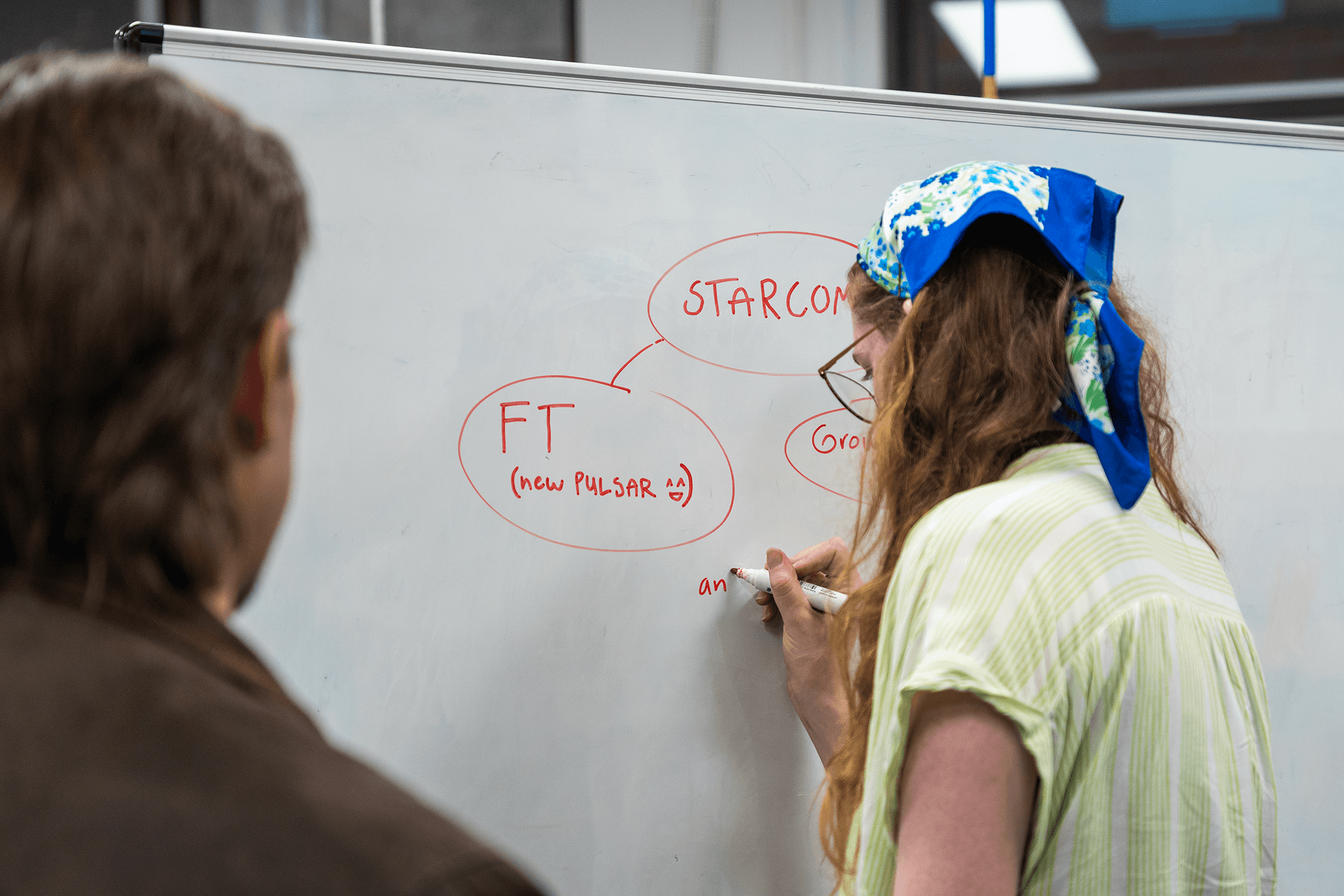
Every student completes a project. For a member of the Team Development department, this meant something that converged law and aerospace into one smooth trajectory. Her mission was to make five changes to the original constitution. For a student of both Law and Psychology, this task was a natural fit; her dual expertise allowed her to balance the rigid legal logic required for a governing document with an understanding of the human behaviour and team dynamics that the constitution must regulate. She achieved her mission, gaining her wings and becoming an accepted member.
Diya clarifies that the constitution is ‘not like a country’s constitution’. As mentioned earlier, it is a living document and one that keeps Diya busy in the lab every week. She approaches it with steady resolve, a sharp mind and two keen eyes, detecting where changes need to be made as the team evolves. PAST is still young in terms of establishment. Policy is past the blueprint stage and is now being integrated into the core flight systems. When change needs to happen, Diya ensures that PAST adapts, using the constitutional framework to propose logical change that creates a less turbulent flight path for the entire team. The constitution is now in its third version, a testament to her ongoing efforts for the team.
Diya isn’t just maintaining the constitution, she is gathering on the ground legal experience for her future in law. ‘I've gotten more insight into organisational stuff. For instance, how a space organisation operates. I have learned adapting what I work on to PAST. For example, when I include our meetings and divisions. I am using terms exclusive to PAST. This is personalisation that requires hands on technical knowledge. It also proves that whatever you are studying or doing, there is something in PAST that you can work on.’
Projects like Diya’s illuminate the multidisciplinary depth required to sustain Western Australia’s emerging space community. Through the Perth Aerospace Student Team, students are not only building CubeSats but also pioneering the legal and organisational frameworks that will define the next generation of aerospace governance. Every constitutional update, policy refinement and governance iteration ensures that PAST and the state’s broader space sector is built on a foundation of absolute structural integrity.
As space operations continue to boom across the Indo-Pacific, the demand for professionals who understand the intersection of human behaviour and aerospace law has never been higher. By treating the team’s constitution as a living mission architecture, Diya is proving that the ‘soft systems’ of leadership and law are just as mission critical as the ‘hard systems’ of sensors and circuitry. Her work serves as a powerful reminder that for a mission to truly reach its trajectory, the human systems designed on the ground must be as precise, resilient and innovative as the hardware launched into the stars.
To learn more about the Perth Aerospace Student Team’s projects or to support student‑led space innovation, connect with the team and follow their progress online.