By:
Louise Kaestner
Last Updated:
Western Australia’s space technology scene is transforming from a niche interest into a significant contributor to the nation’s growing space capability. From advanced ground station networks to CubeSat development led by student teams, the state is positioning itself as a centre for innovation in satellite engineering. Within this landscape, Attitude Determination and Control Systems (ADCS) play a vital role—ensuring that satellites, no matter how small, can precisely orient themselves in orbit to communicate, gather data and operate efficiently in the harsh environment of space.
Within the Perth Aerospace Student Team (PAST), ADCS is one of four core departments driving CubeSat development. The team’s mission centres on ensuring that a satellite can orient itself accurately in orbit and maintain stability during operation—a challenge that demands both precision and creativity. Leading this effort is Aiden, a mechatronics student spearheading ADCS initiatives and pushing the boundaries of what small satellite technology can achieve.
Every CubeSat undergoes a rigorous testing process before launch—and even the technology used to test it, such as the testbed, must prove its reliability first. Innovation rarely happens in a single leap; it evolves through many iterations as designs are tested, analysed and refined.
A testbed is an experimental platform designed to simulate real-world conditions and validate the performance of systems before they are deployed. In the context of CubeSats, a testbed allows engineers to replicate aspects of the space environment—such as microgravity, frictionless motion or sensor response—to evaluate how components interact and perform under controlled conditions. By doing so, teams can refine hardware and software designs early in development, reducing risk and ensuring mission success once the satellite reaches orbit.
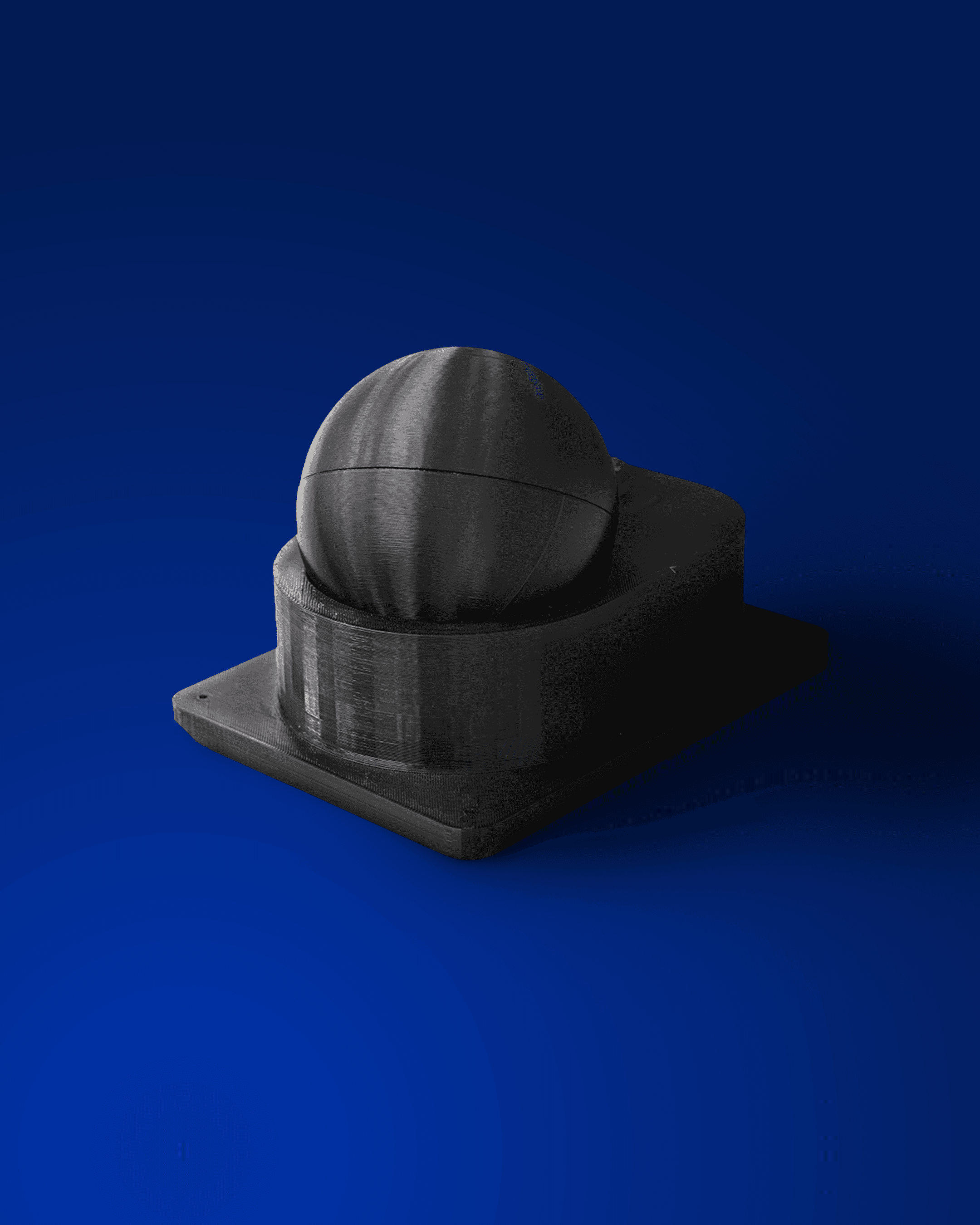
Aiden’s 3D‑printed testbed consists of two main components: the stator, a stationary base where air flows through to simulate a space‑like environment, and the sphere, which represents the CubeSat. In the accompanying video, you can see the first and second iterations of his design, with at least two more versions of the stator and one additional sphere planned. The system uses an air compressor to supply air to a three‑axis air bearing—the stator—which allows the sphere to move freely, simulating the frictionless conditions of space. Once the testbed’s development phase is complete, it will be capable of housing a CubeSat for real‑world testing. Beyond that, it can also serve as a platform for evaluating any sensor or actuation system in a controlled zero‑gravity simulation.
During testing, Aiden gathered valuable performance data from the testbed. The results reveal how the system behaves under different conditions and highlight the complexity of tuning such a precise mechanism.
The 40‑second anomaly: While rotational speed generally fluctuated between 23 and 34 rad/s, a sharp spike to 37.7 rad/s occurred exactly at 40 seconds—a 20 percent increase from the initial speed. Since readings at 35 and 45 seconds both returned to 25.1 rad/s, this anomaly likely represents a brief burst or sensor error rather than a sustained acceleration.
Stabilisation at the end: Between 50 and 60 seconds, the system reached a perfectly steady state with speed holding at 23.9 rad/s—about 24 percent lower than its starting rate. This indicates that the setup eventually settled into uniform motion after earlier fluctuations.
Non‑linear progression: Although total spins increased consistently, the corresponding speed data showed a non‑linear pattern—a gradual rise (0 to +8 percent from 0–15 seconds), a decline to –20 percent by 35 seconds, a brief spike at 40 seconds and eventual stabilisation at –24 percent.
These findings demonstrate how even a controlled test environment can produce complex dynamic behaviour, underscoring the importance of iterative calibration and precise measurement in ADCS research.
3D printing brings both advantages and challenges to engineering projects. It allows complex components to be produced quickly and cost‑effectively using accessible materials and ready‑to‑print designs. However, as Aiden discovered firsthand, material properties can present unexpected hurdles: ‘The friction between 3D‑printed materials is very high, so be careful printing threads that mate together—they may never come apart.’ It’s a simple but valuable lesson that highlights the importance of hands‑on experimentation in additive manufacturing.
For students like Aiden, this hands-on learning is what turns theory into practice. Being part of PAST isn’t just about launching a CubeSat into space—though, admittedly, that’s part of the fun. The team offers invaluable learning and growth opportunities for students from a range of disciplines. As Aiden explains, ‘The personal skills I’m developing, beyond 3D software, include computational fluid dynamics to ensure the airflow to the stator is even and suitable for the application’. Fluid mechanics is the field of physics and engineering that studies how fluids—liquids, gases and plasmas—behave at rest and in motion. Computational fluid dynamics (CFD) builds on this by using numerical analysis and simulation to model how those fluids interact with complex surfaces, providing crucial insights for real‑world engineering design.
Projects like Aiden’s highlight the innovation and curiosity driving Western Australia’s emerging space community. Through the Perth Aerospace Student Team, students are not only building CubeSats but also developing the technical and collaborative skills that will define the next generation of aerospace engineers. Each prototype, simulation and test iteration brings both PAST and Western Australia one step closer to a stronger foothold in the global space industry—proving that big ideas can take flight from the lab benches of students right here at home.
To learn more about the Perth Aerospace Student Team’s projects or to support student‑led space innovation, connect with the team and follow their journey.